Our Top Picks
We spent hours searching for the best concrete saw available online. Here’s a quick overview of the best ones we’ve found.
If you’d like a more indepth take, feel free to scroll down to our product review section and take a look at our buying guide while you’re there. Enjoy!
Best Concrete Saw Comparison
| IMAGE | PRODUCT | |
|---|---|---|
Best Overall  |
| View On Amazon →Read Our Review |
Best Gas Powered  |
| View On Amazon →Read Our Review |
Best Battery Powered  |
| View On Amazon →Read Our Review |
 |
| View On Amazon →Read Our Review |
 |
| View On Amazon →Read Our Review |
Table of Contents
| Topic | Page |
| Quick Introduction to Concrete Saws | 2 |
| Best Concrete Saws Reviewed – Best Overall – SKILSAW SPT79-00 – Best Gas Powered – Husqvarna K770 – Best Battery Powered – DEWALT DCS690X2 – Best Compact – Makita 4100 KB – Best Budget Friendly – Evolution R300DCT | 3 – 7 |
| Bonus Products | 8 |
| Best Masonry Blades | 9 |
| Concrete Saw Buying Guide – Types of Concrete Saw – Common Subcategories – Important Factors – Safety and Maintenance Tips | 10 – 14 |
| FAQs | 14 |
| Conclusion | 15 |
Quick Introduction to the Best Concrete Saws
A concrete saw also known as a consaw, slab saw or cut-off saw, is a power tool that specializes in cutting masonry such as concrete, bricks, asphalt, tiles, granite and marble slabs.
Concrete saws are capable of cutting through these tough materials with the use of diamond saw blades or abrasive blades similar to those used in circular saws. Unlike circular saws however, some concrete saws can be gas powered, hydraulic and even pneumatically powered along with the common electric alternative.
Concrete saws are commonly used by contractors, road workers and stonemasons in construction sites or for personal projects. These specialty power tools can be quite the investment and come in all shapes and sizes. Don’t worry though because in this article, we’ll be going over our list of recommended concrete saws and the basics of what every concrete saw owner should know. By the end of this article, we hope that you’ve learned a thing or two and have a better idea on which concrete saw is best for you.
Reviews of the Best Concrete Saws
Best Concrete Saw Overall:
SKILSAW SPT79-00
Saw Specifications:
- Motor: 15 amp motor
- Max RPM: 5,100 rpm
- Blade Capacity: 7 inches
- Blade Location: Left
- Max Cutting Depth: 2 inches
- Arbor: ⅞ inches
- Weight: 16.9 lbs
Saw Features:
- Worm drive geared
- For wet cutting & dry cutting
- Retractable cut line guidance system
- Integrated rolling foot plate
- Integrated dust port

Overview:
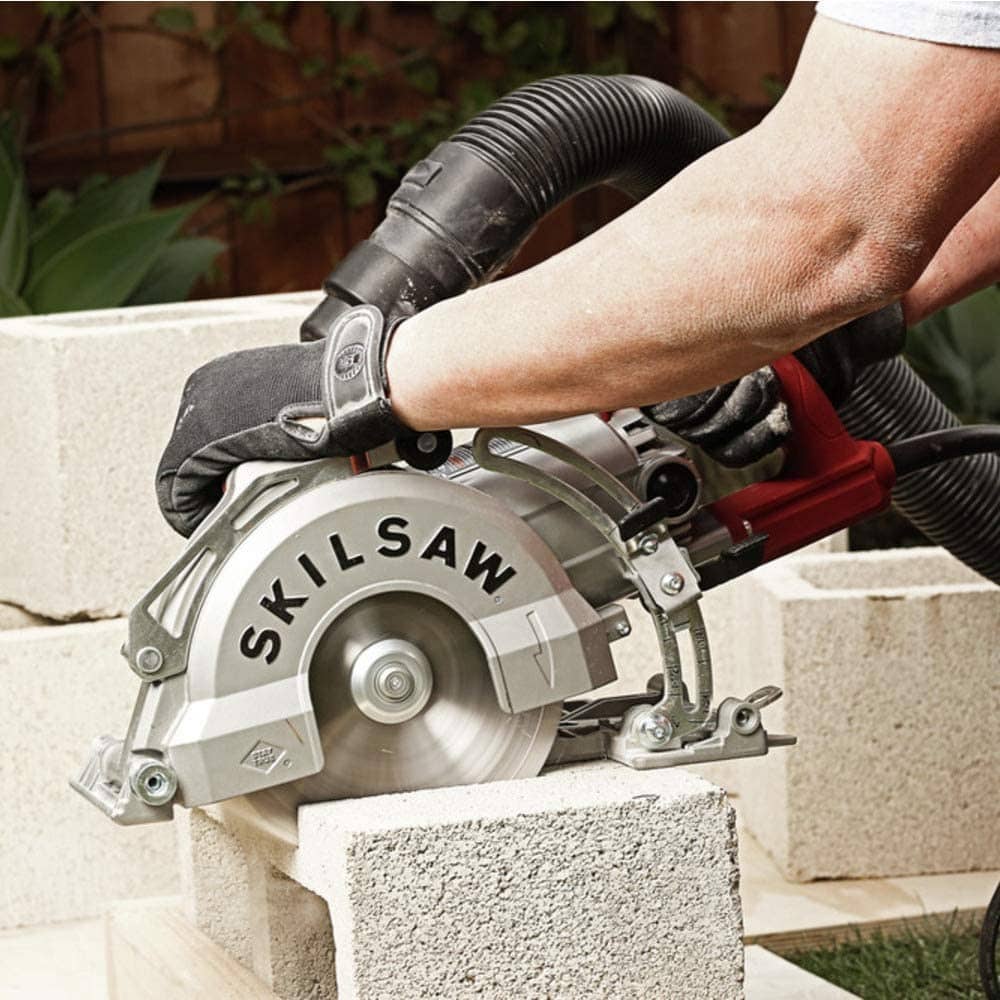
SkilSaw brings their legendary worm drive system to a portable concrete saw which offers users unparalleled cutting power and comes with a wide range of options to add on.
The SkilSaw SPT79-00 comes with a powerful 15 amp Dual-Field motor designed to keep it running cool and smooth through cutting sessions. Complementing its powerful motor is the worm drive that helps it power through tough materials with ease. This concrete saw has a plunge lock feature that lets you make cuts anywhere on the surface of the slab for added convenience. The saw was designed to be used for wet or dry cutting and even comes with an integrated dust port on the auxiliary handle for maximum dust management. It also has a sturdy aluminum housing along with rust resistant brackets and fasteners that help in longevity.

This concrete saw has add ons such as two blade options you can choose from including a turbo or segmented diamond blade and even a walk behind attachment that lets you set the saw along the floor while you’re working.
The SPT79-00 is the perfect companion to stonemasons or contractors and earned its place at the top of our list. Check out the SKILSAW SPT79-00 concrete saw here.
Best Gas Powered: Husqvarna K770
Saw Specifications:
- Motor: 5 HP, 73.5 CC engine
- Max RPM: 4,700 rpm
- Blade Capacity: 13 inches
- Blade Location: Front
- Max Cutting Depth: 4.9 inches
- Arbor: .7 inches
- Weight: 22.4 lbs
- Fuel Ratio: 50:1
Saw Features:
- 2 stroke engine
- Poly V-Belt drive
- Cast magnesium crankcase
- Easy belt tensioning
- Easy to start
- Maintenance free air filter

Overview:
This gas powered concrete saw from Husqvarna is a great all around power cutter capable of cutting through a wide range of masonry with its 13 inch blade and 5 HP engine.
The Husqvarna K770 concrete saw is a lightweight and compact yet powerful machine capable of running for long cutting sessions as long as you have the fuel supply. It features a heavy duty cutting arm that extends the blade towards the front of the machine, giving you better cutting depth and more maneuverability. It features a pol-v belt drive and a maintenance free air filter, ensuring that the saw runs smooth even during tougher jobs.
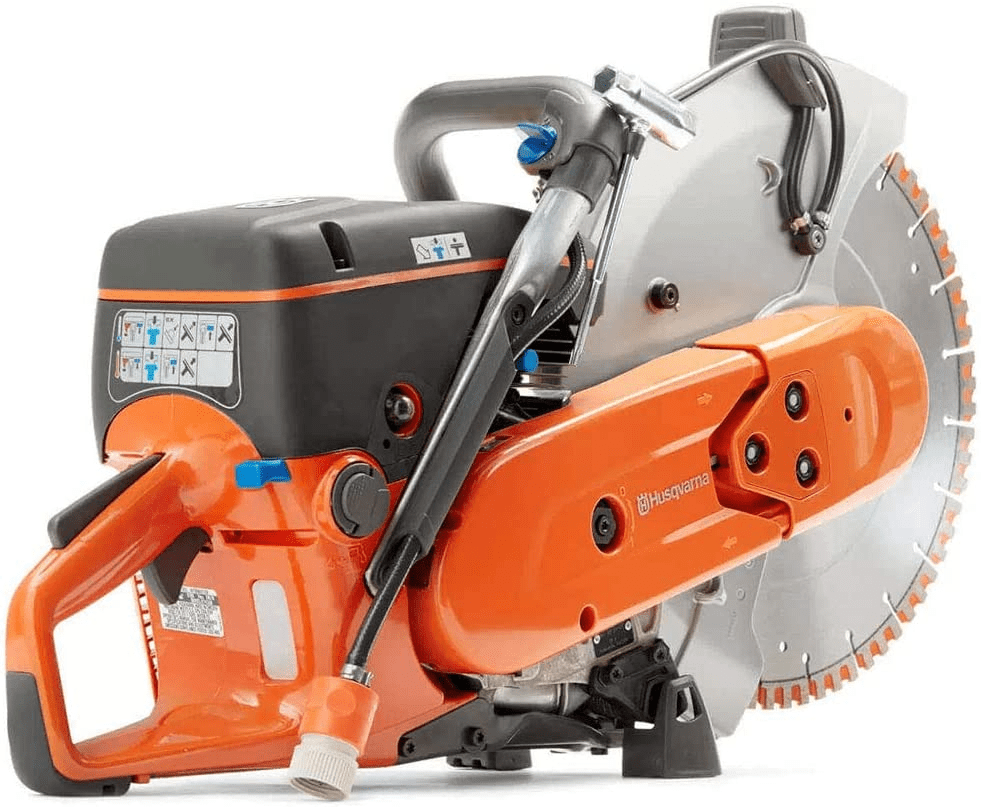
Being a gas powered concrete saw, the 73 cc engine runs on a fuel mixture ratio of 50:1 and is designed to be more fuel efficient and have less emissions. It also features a digital ignition system together with an air purge system which ensures a hassle free start every time.
This concrete saw is ideal for tasks such as construction work, renovations, and even road work when paired with the Husqvarna KV7 trolley.
Check out the Husqvarna K770 concrete saw here.
Best Battery Powered:
DEWALT DCS690X2 Cut Off Saw
Saw Specifications:
- Battery: Flexvolt 60V battery
- Max RPM: 6,600 rpm
- Blade Capacity: 9 inches
- Blade Location: Front
- Max Cutting Depth: 3 ¼ inches
- Arbor: ⅞ inches
- Weight: 10.85 lbs
Saw Features:
- Beltless metal drive train
- Wet dust management system
- 5 cutting positions
- Heavy load indicator
- Fast charger included
- Includes two 20V/60V MAX Li-Ion batteries
- 3 year warranty

Overview:
The Dewalt DCS690 cut off saw offers users heavy duty cutting action on a portable platform that you can easily carry with you from jobsite to jobsite. The Dewalt DCS690 is a perfect pick if you’re looking for a battery powered alternative that does not compromise its mobility for power.
The DCS690 features a brushless motor powered by a DCB609 9.0Ah battery that spins the blade to a max RPM of 6,600. With a single fully charged battery, you can cut up to 96 pieces of rebar or cut 22 cinder blocks in half. The kit comes with two of those batteries and a fast charger for more work and less down time. The battery is protected from water, dust and other foreign elements by a latch located conveniently between the handles.
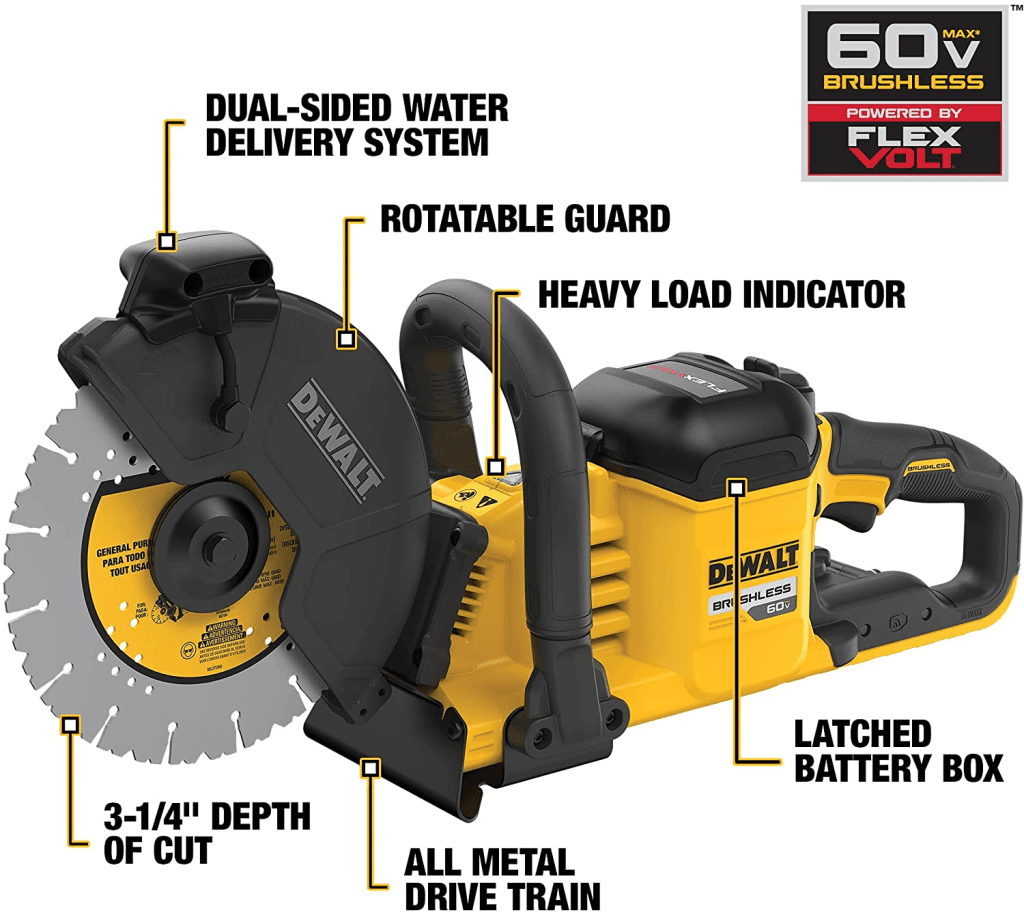
The saw comes with a dual sided water feed system that greatly helps with dust control when making wet cuts and a rotatable guard that locks in 5 cutting positions for more flexibility. This kit also comes with a diamond cutting wheel and an abrasive cut off wheel as an added bonus.
Check out the DEWALT DCS690X2 cut off saw here.
Best Compact Concrete Saw:
Makita 4100 KB
Saw Specifications:
- Motor: 13 amp motor
- Max RPM: 12,200 rpm
- Blade Capacity: 5 inches
- Blade Location: Left
- Max Cutting Depth: 1 9/16 inches
- Arbor: 13/16 inches
- Weight: 6.6 lbs
Saw Features:
- Transparent guard assembly
- Integrated dust port
- Dust bag included
- Easy depth adjustment
- For dry cutting
- 8.2 foot power cord
- 1 year warranty

Overview:
The Makita compact masonry saw is a great home option for tile cutting, bathroom renovations and driveway repairs.
The Makita 4100 KB concrete saw has a 13 amp motor that turns the 5 inch blade at speeds of 12,200 RPM. That blistering fast speed generates a lot of dust and Makita solves this by adding in a dust port built right into its transparent blade guard. Makita also throws in a dust collection bag that fits snuggly on the dust port in case your shop vacuum doesn’t reach.
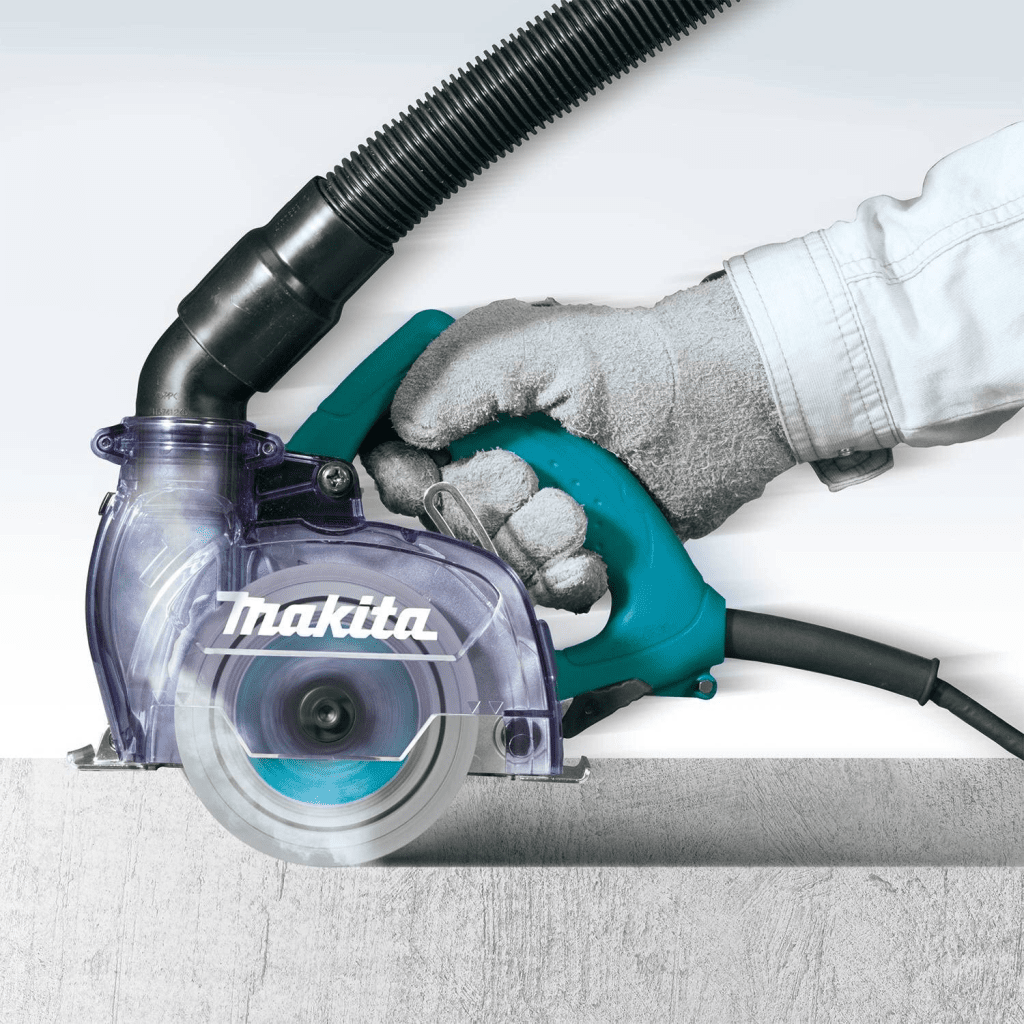
The whole saw is built with dust mitigation in mind because it is meant to be used for dry cutting only. Design changes have been made to accommodate this such as a dust protected trigger switch, a rubber easy-to-adjust depth gauge and a 8 foot double insulated power cord.
The Makita 4100 KB is the perfect companion for smaller DIY projects that offers both homeowners and professionals quality cutting power in a small package.
Check out the Makita 4100 KB here.
Best Budget Friendly:
Evolution R300DCT
Saw Specifications:
- Motor: 15 amp motor
- Max RPM: 4,600 rpm
- Blade Capacity: 12 inches
- Blade Location: Front
- Max Cutting Depth: 4 ½ inches
- Arbor: ⅞ inches
- Weight: 21.4 lbs
Saw Features:
- High torque motor
- Soft start feature
- Integrated dust port
- Adjustable blade guard
- Integrated tool storage
- Electric brake
- For wet cutting & dry cutting
- 3 year warranty

Overview:
This concrete saw from Evolution Power Tools is designed to be user friendly, making it easier for workers to cut through concrete, brick and other masonry while still coming in at a reasonable price tag.
The Evolution R300DCT comes with a bunch of features that gives it more bang for the buck such as a 15 amp motor that powers its 12 inch general purpose diamond blade to reach speeds of 4,600 rpm, an adjustable blade guard, a steel wrap around handle that lets you hold the saw in various positions, a soft start and electric brake feature along with Evolutions Power Protect Technology that ensures that the saw runs at peak performance for years.
This concrete saw can be used for both wet or dry cutting and has some design changes added in to help with this. These include an integrated dust port that maximizes dust control and collection along with a built-in drainage system that lets water escape from inside the machine and prevents damage to any internal components.
All these features on a product that’s half the price of its competitors is a bargain for anyone looking for a concrete saw. Evolution stands behind the quality of their product and even includes a 3 year warranty. Check out the Evolution R300DCT here.
Bonus Products
Here are some concrete saws that didn’t quite make our list but we think deserve a shoutout.
| Model | Features and Link |
 Makita Gas Concrete Saw EK7651H | Specs & Features: Motor: 4 stroke, 75.6 cc engine Max RPM: 4,300 rpm Blade Capacity: 14 inches Blade Location: Front Max Cutting Depth: 4 inches Arbor: 1 inch Weight: 28.4 lbs Soft start feature Low emission, low noise & low consumption For wet and dry cutting |
 Evolution DISCCUT1 | Specs & Features: Motor: 15 amp motor Max RPM: 5,000 rpm Blade Capacity: 12 inches Blade Location: Front Maximum Depth: 4 inches Arbor: 1/8 inch Weight: 21 lbs Instant start feature Low sound rating Ergonomic wrap around handle bar Maintenance free 3 year warranty For wet and dry cutting |
 Stark 3200W | Specs & Features: Motor: 15 amp motor Max RPM: 4,700 rpm Blade Capacity: 16 inches Blade Location: Front Max Cutting Depth: 6 inches Arbor: 1 inch Weight: 39.1 lbs For wet & dry cutting Water line attachment included Efficient dust extraction |
Best Masonry Blades
Here’s some masonry blades we recommend to go along with these concrete saws.
| Model | Features and Link |
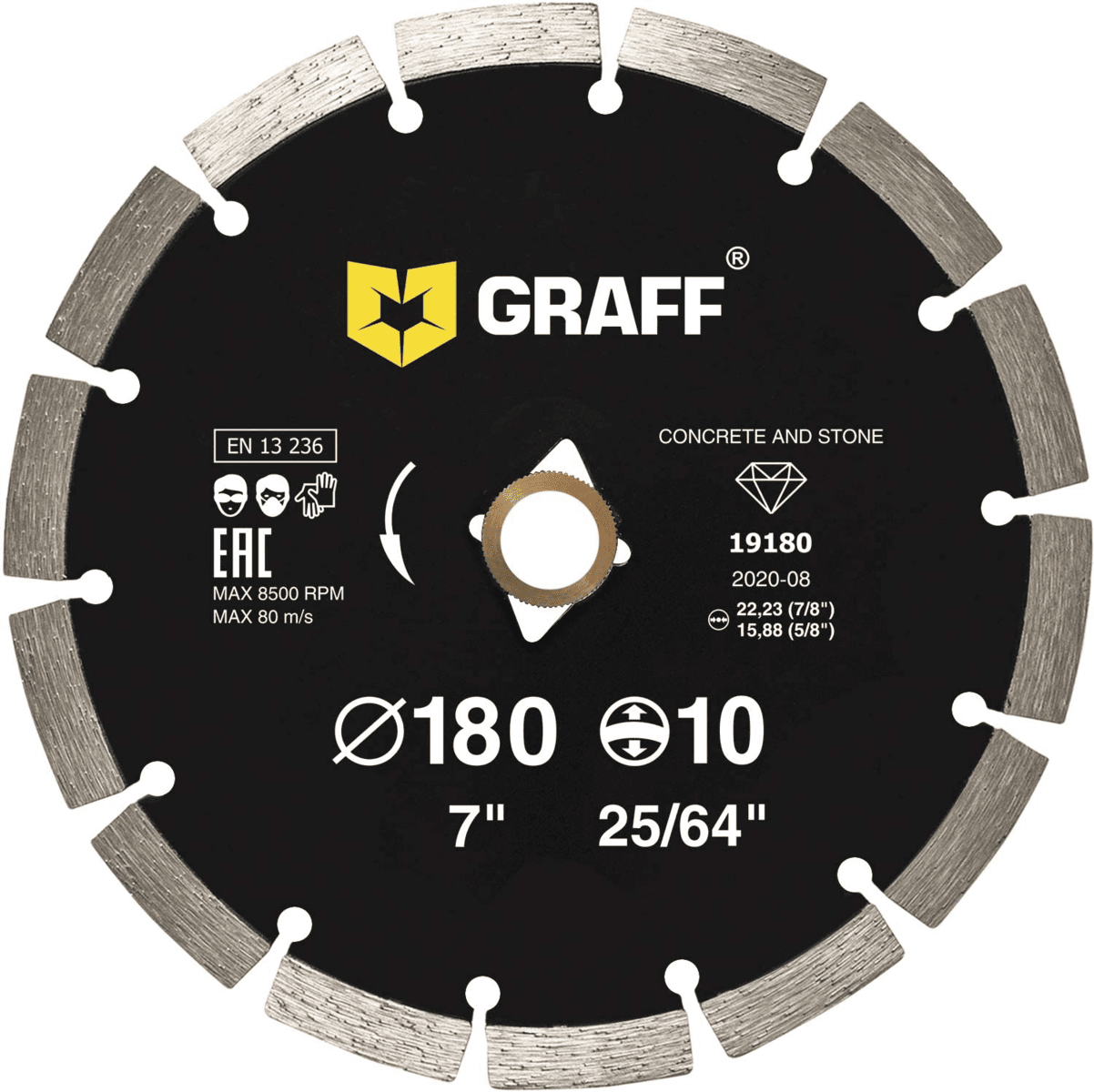 GRAFF Diamond Blades | – Blade Specs & Features – Size Options: 4, 4½, 5, 6, 7, 8, 10 & 12 inch blades – Compatible Material: Marble, Stone, Concrete, Granite, Asphalt, etc. – Arbor: ⅞ inches – For both wet & dry cutting – Maximum speed: 8,500 rpm – Easy to sharpen |
 VTXMax Masonry Blades | – Blade Specs & Features – Size Options: 4½, 5, 7, 9, 10, 12 & 14 inches – Compatible Material: Brick, cement, concrete, asphalt, different types of stone – Arbor: ⅞ & ⅝ inches – For both wet & dry cutting |
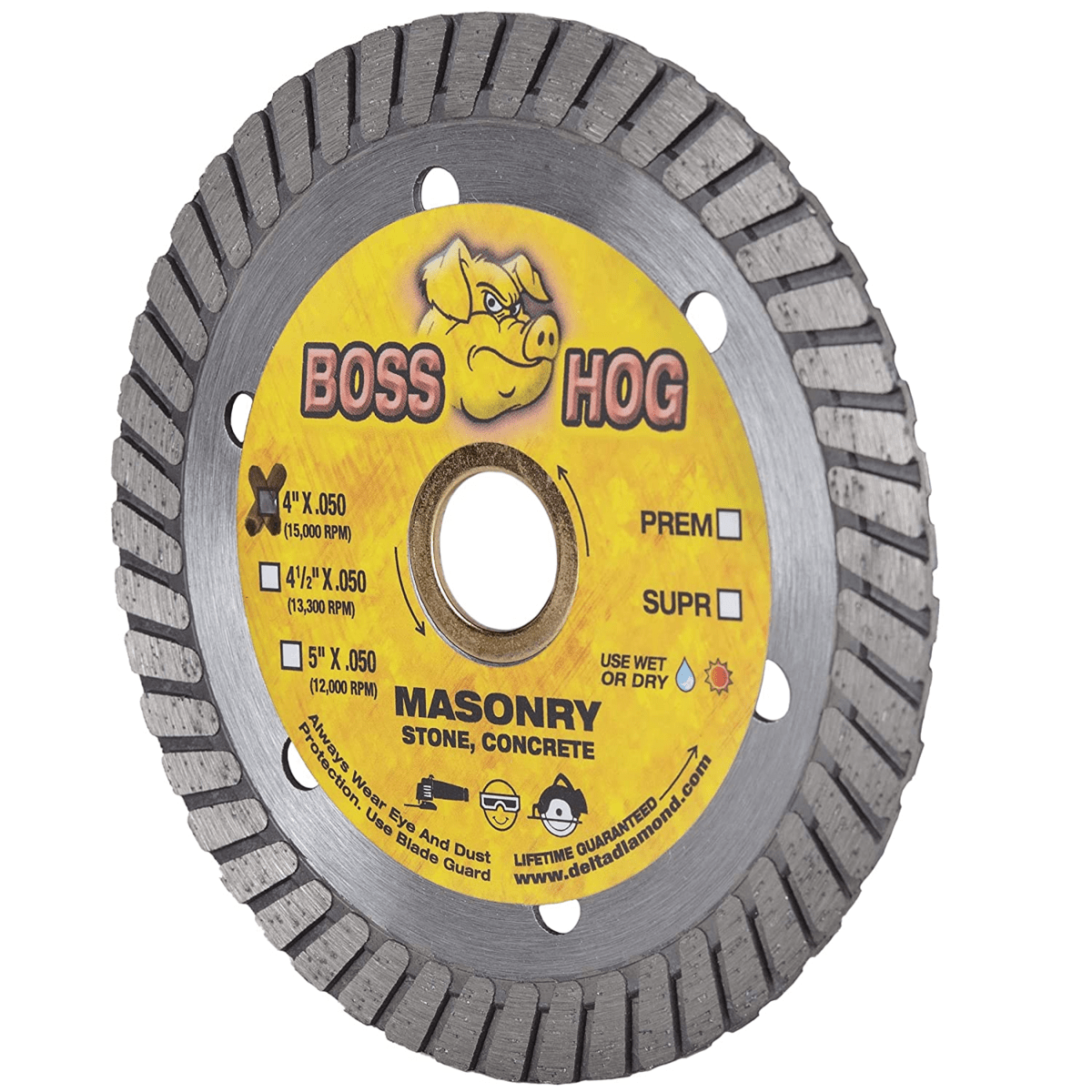 Delta Diamond Boss Hog Turbo Blades | – Blade Specs & Features – Size Options: 4, 4½, 5, 7, 8, 10 , 12 & 14 inches – Compatible Material: Masonry and various types of stone – Arbor: ⅞ & ⅝ inches – Cooling holes – For both wet cutting & dry cutting – Lifetime warranty – Heat treated steel core |
Concrete Saw Buying Guide
Types of Concrete Saw
There are two main types of concrete saw that can be found throughout the market. These are the electric and gas powered concrete saws. Let’s break down the two.
Gas Powered Concrete Saws
These concrete saws are workhorses that are often seen in construction sites or road works. Gas concrete saws are the most powerful variant and are meant to be the most robust, capable of withstanding harsh punishment from jobsite conditions along with the tough material they’re meant to cut. These saws can be used anywhere, for wet and dry cutting, as long as you have the fuel supply.
Being gas powered, a lot of space needs to be allocated for internal components such as the gas tank and engine thus, gas powered concrete saws almost always have their blades in the front position because of the engine size and the size of the blade.

Gas concrete saws do have some disadvantages however such as loud noise levels, harmful fumes, they are often heavier, more expensive and costly to maintain.
Electric Powered Concrete Saw
Electric powered concrete saws on the other hand, come in two variants namely the corded and cordless variants.
Cordless or battery powered concrete saws on the other hand, are a more mobile and convenient variant. You can take them where you need them but keep in mind that you’ll eventually need to replace or recharge the battery. Although they’re less powerful than corded and gas powered models, most cordless models have enough fully charged battery life to cut through dozens of rebar and cinder blocks at a time. Whether this is enough depends entirely on your needs and situation.
To start off, corded concrete saws are lightweight, user friendly and low maintenance. These models require a socket to function which may limit their range so an extension cord is a must when you choose to purchase one.
These models can run for as long as you need them to and you don’t have to worry about switching out batteries or gas. More recent models are feature rich, beginner friendly and are a great choice for both hobbyists, homeowners and professionals alike. Corded models are also often the cheapest variants and some are on par in terms of cutting power as their gas powered relatives
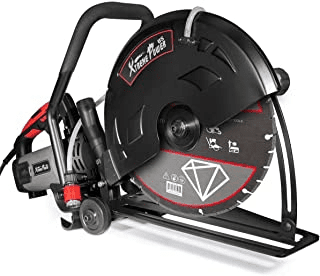
Some good reasons to consider going cordless is the added mobility and the environmentally friendly benefits an electric concrete saw has. Manufacturers also tend to make entire product lines that share the same battery type and this is a great incentive to invest in one brand of cordless tools.
Common Subcategories

Besides the two main types, here are some common subcategories of concrete saws that you’ll likely run into.
Walk Behind Concrete Saw
As the name suggests, the operator of this saw would be positioned behind it as the saw cuts along the ground, hence the name walk behind concrete saw. These saws are commonly used on asphalt, pavement, tiles and stones. Walk behind concrete saws are considered a specialty tool but some newer concrete saw models come with an attachment that’ll turn a handheld saw into a walk behind saw.
Compact Concrete Saws
Cut-Off Saws
A cut-off saw is a common type of concrete saw that features a large blade positioned towards the front of the saw. These are commonly found on construction sites and are used for cutting through slabs of masonry including concrete. Some models are even used in rescue operations.
Cut-off saws come in gas, electric and even pneumatic powered models depending on the industry.
Compact Concrete Saws
This subcategory of concrete saw is commonly used for smaller tasks such as cutting tile for bathroom renovations. Compact concrete saws are popular among professionals and DIY enthusiasts alike because of their cheaper price tags, low maintenance, high mobility yet very capable motors. Compact concrete saws most resemble circular saws in size, shape and even share the same masonry blade.
Important Factors
Types of Masonry Blades
Here are some of the most common types of masonry blades you might come across.
Diamond Edged Blades
These are specialist blades that are used for cutting very dense and hard material such as stone.

Continuous Rim Blades
Continuous rim blades are designed for use on materials like tile and slate. Diamonds affixed to the edge of the blade cut through the material. These blades create a very clean finish. Some brands can be used in dry cutting, wet cutting or both.
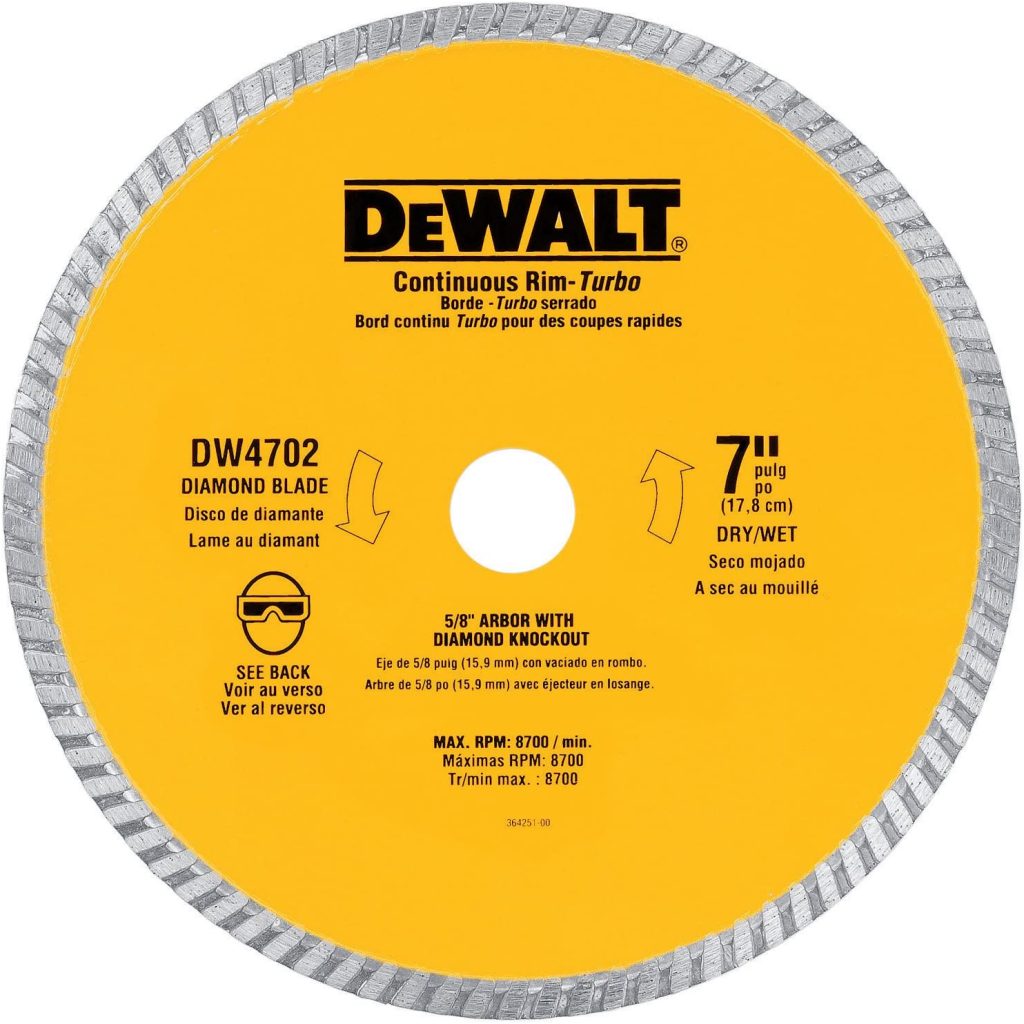
Turbo Rim Blades
These are similar to continuous rim blades but have a serrated rim that cuts materials like brick and concrete. These blades cut more aggressively than continuous rim blades but don’t leave as clean of a finish.
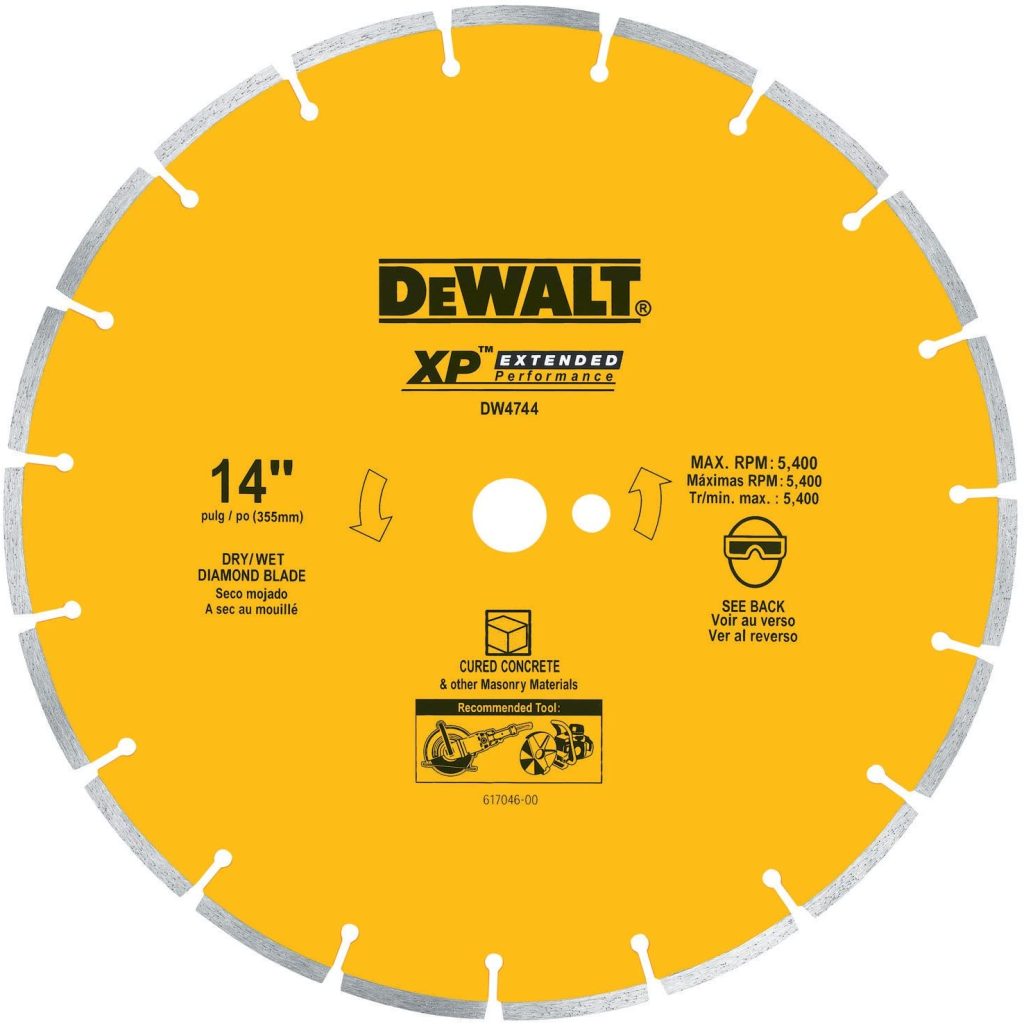
Segmented Blades
These also cut with diamond edges but have a rim divided by gullets similar to those on serrated blades. The segments create the most aggressive cut of the diamond blades. These blades cut more quickly than the other types and can handle tough materials, like brick and concrete but leave a rougher finish.

Abrasive Blades
These can cut materials like brick and concrete. Some abrasive blades are suitable for cutting metal as well. Similar to diamond blades, they don’t have saw teeth. They cut using abrasive materials such as silicon carbide or aluminum oxide.
Arbor Size
Concrete saw blades need a lot of support to connect with the rest of the saw assembly. A shaft, also referred to as a spindle or mandrel, protrudes from the assembly to form what we refer to as the arbor. The motor drives the arbor and causes the saw blade to rotate safely.
The arbor size of the blade helps determine the compatibility between a power tool. For example, standard 7 inch blades have arbor hole diameters that typically sit at 5/8 inches. Arbor sizes can differ per brand although many manufacturers design their blades to have standardized arbor hole sizes for convenience.
Maintenance & Safety Tips
Concrete saws are powerful machines that can be a serious hazard when used incorrectly. Here are some basic steps you can take to avoid accidents and take better care of your concrete saw.
- Make sure you have a proper dust management system in place. Concrete saws can throw around a lot of dust when cutting through masonry. These dust particles can be a serious problem that can cause respiratory illnesses along with other health concerns. Some common forms of dust control are with the use of vacuum attachments, a dust collection bag attachment or with the use of the wet cutting technique that uses water to absorb the dust.
- Wear the appropriate PPE. Personal protective equipment or PPE for short, is a term used to describe protective equipment that should be worn at all times when doing a specific task or when using a specific tool. In the case of a concrete saw, it is highly recommended that you wear a respirator, safety goggles and ear protection. If you’re using a concrete saw on job sites or construction sites, there’s a chance you’ll need a hard hat, steel tipped boots and even a PPE safety vest when using a concrete saw.
- Always check the concrete saw before and after use. Before you even turn on the concrete saw, you should have a mental checklist of things that you need to check first. This can include damages to the power cable for electric concrete saw, gas leaks for gas powered concrete saws, loose arbor locks and damaged blades.
- Clean the concrete saw after a cutting session. While most saws are built to be durable and can run even when covered in dust, it is still necessary to clean the power tool to keep it running at its peak performance. This can include removing the blade and wiping it down along with the arbor area, cleaning out the motor housing of any built up dust and even washing it down with warm water to get rid of dried up dust.
FAQs
Q: How long should a masonry blade last?
A: While the lifespan of your blade depends on factors such as frequency of use and type of material you’re cutting, there are several ways you can tell when it’s time to get a new blade. Here are some signs to look out for that’ll let you know your blade is not up to speed anymore.
- You may notice some unusual vibrations from the blade when in use.
- It will start to cut slower than usual and the dust particles may not be as fine.
- The blade might have cracks or breaks along its edges.
- You will start to see the steel core of the blade.
- The blade will sound different when cutting through masonry.
Q: Are concrete saws and circ saws the same?
A: While concrete saws and circular saws look the same and even use the same masonry blades, there are distinct differences. Circular saws can come in smaller variants and are meant to be more general purpose than concrete saws. Concrete saws on the other hand can be significantly bigger, more rugged and more powerful than your standard circular saw because of the type of material concrete saws are designed to cut. This isn’t to say that circular saws can’t cut masonry as well, concrete saws just do this task better.
Q: Can concrete saws be used to cut wood?
A: In theory, concrete saws can be used to cut other materials such as wood and even rebar given that you have the appropriate blade for the job. Circular saws are better suited for cutting materials such as wood and are designed around those tasks.
Conclusion
Concrete saws are powerful tools and are a necessity in many industries for various jobs. We hope that this article has given you a better understanding of concrete saws and that you leave here with one of the items on our list. Thank you for making it to the end with us dear reader and happy cutting!