
When shopping for a Japanese saw for woodworking, you will likely encounter different styles and configurations. These have unique names that you may be unfamiliar with. Below is a definitive guide to Japanese saws to help you make a wise purchasing decision.
Japanese saw blades come in three main styles—kataba, ryoba, and dozuki. Kataba saws have a single set of cutting teeth, whereas ryoba saws offer dual blades. Meanwhile, dozuki saws feature a spine to support the blade while cutting.
These are just a few of the many Japanese saw types available today. This article teaches you other saw configurations and styles that suit your project needs. We will also cover the benefits of Japanese saws and tips on using them properly.
What Is a Japanese Saw?
A Japanese saw, also called the Nokogiri, is a type of hand saw that cuts materials with a pulling force. Also known as a pull saw, it is the opposite of most European saws that use a push stroke.
A Japanese saw features a strong, thin blade with a narrow kerf. It requires less power, so you can cut materials for longer periods with less fatigue. It also produces more accurate cuts, ideal for woodworking projects that need precision.
Japanese saws come in different configurations and styles (more on this topic later). These make them suitable for specific tasks.
Overall, Japanese saws are popular for their durability, efficiency, and versatility.
What Are the Different Japanese Saw Types?
A Japanese saw, or Nokogiri is available in various shapes and sizes. It is usually categorized into three main styles, namely kataba, ryoba, and dozuki. However, other designs are also common.
Below, we will show you the nine Japanese saw types you can buy today.
Kataba
Kataba is among the most popular Japanese saws for woodworking.
It only offers a single row of teeth without a back or spine support. It is similar to a western panel saw because it can make long and deep cuts.
The teeth on a Kataba saw are larger and coarser than other Japanese saw types. They come in either crosscut or rip-tooth configurations. These enable them to cut through thick wood panels.
Meanwhile, the single edge of the Kataba saw gives you greater control and accuracy while slicing wood. It can also cut different materials faster, owing to its wide kerf. Kerf simply refers to the width of the material removed during the sawing process.
Kataba saws even come in a folding version with a plastic handle. It is suitable for those who prefer a compact handsaw.
Ryoba

The Ryoba Japanese saw is another common woodworking tool. Unlike the Kataba, this Japanese saw type has two cutting edges.
The teeth sit on both sides of the blade where one half is crosscut and the other is rip cut. These give the Ryoba-style saw a dual purpose.
Meanwhile, the pitch, or the number of teeth per inch, varies on the location. The end of the stroke cuts more aggressively than the starting edge of the saw (closer to the handle).
As for its length, the Ryoba hand saw comes in different sizes ranging from 180mm to 295mm. Smaller units are suitable for detail and furniture work. In contrast, large Ryoba saws are common in carpentry and heavy ripping tasks.
Dozuki
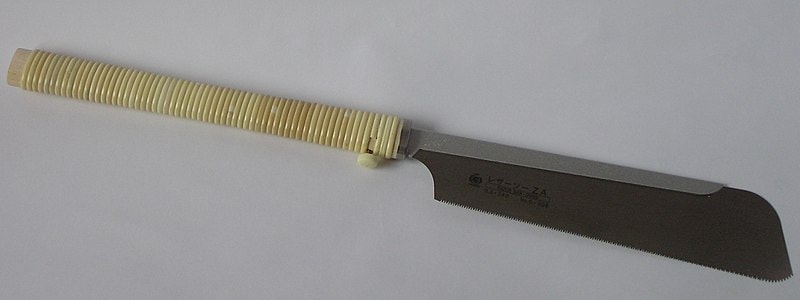
Dozuki is another common Japanese saw type. It features a thin, flexible blade with back support. This solid spine is usually made with steel or brass that runs along the blade’s top edge. It firmly holds the saw in place to prevent bending.
The slim blade in a Dozuki-style saw gives you very narrow kerfs. It can make smooth and precise cuts. It is ideal for cutting dovetail joints, tenon shoulders, miters, and other detailed woodworking projects.
Azebiki
Azebiki is among the smallest Japanese saw types you can buy today. It comes in either a Kataba (single-blade) or a Ryoba (dual-blade) version.
The Azebiki panel saw comes with curved edges, a long neck, and a tapered edge. Its unique design allows you to cut at the center of the wood panel. Simply rock its handle to puncture the wood. It is ideal for cutting holes, sliding dovetail joints, and producing intricate shapes.
Azebiki saws also feature smaller and finer teeth than other types of Japanese saws. They create a clean, precise cut and prevent the wood from splintering.
Mawashibiki
Mawashibiki, roughly translating to “turning pull saw,” is another backless saw with one set of cutting teeth like the Kataba.
However, the Mawashibiki-style saw uses a softer steel blade for more flexibility and a lower risk of breaking. As for the blade shape, it is narrow and long, similar to a keyhole saw.
Mawashibiki saws can effectively cut round edges or corners. They are also ideal for creating various designs and shapes.
Kugihiki
Also known as the flush cut saw, the Kugihiki features a single, narrow blade. The cutting teeth are non-set and ground on two angles. That means they can make precise cuts close to the wood’s surface.
The Kugihiki saw is common in traditional Japanese carpentry. It is also suitable for trimming dowels, small tenons, and other detailed cuts.
Anahiki
The Anahiki Japanese saw features a long blade with one set of cutting teeth. However, some come in Ryoba or dual-blade versions.
Anahiki saws usually have a 310 to 460mm blade length. They make cross cuts against the wood grain. These make them ideal for cutting logs, beams, large timber pieces, and other preliminary rough work.
Maebiki
Maebiki is a large Japanese saw for quickly ripping large pieces of wood. Also known as a whaleback saw, it has a distinct body and a wide blade.
The blade length of a Maebiki Japanese saw varies from 400mm and longer. It can make long, straight cuts. It is also suitable for sawing large logs into smaller boards and timbers.
However, a Maebiki saw is heavy with a large handle. It can be operated by an individual. But it is best if two people use it simultaneously.
Osachiki
Osachiki is a Kataba-style saw with a short blade length of 130 to 140mm. It can make another tool. It also cuts through a block of a Japanese plane to shape wood.
What Are the Benefits of Using a Japanese Saw?
Japanese hand saws offer several benefits compared to a usual western saw. Below are the advantages of using this type of handsaw.
Clean and Accurate Cuts
Japanese saws usually have thinner and more flexible blades than western or European saws. They also require a pulling motion to make the cut, which lowers the risk of the blade bending or snapping.
As such, Japanese pull saws can make cleaner and smoother cuts. They also prevent the wood from tearing out and splintering.
Lightweight
A Japanese saw includes a wooden handle often made with softwood. It also has a slimmer profile than equivalent western saws.
These features make most Japanese saw types lightweight and compact. They are easy to carry and use in small wood workshops.
Durable
A Japanese saw blade uses high-quality steel. It can last for several years with proper care and maintenance.
If the blade gets dull, professional Japanese saw sharpeners known as metate-shokunin are available. However, most craftsmen and woodworkers buy a new blade, which comes cheap, instead of sharpening it.
Versatile
Japanese saws come in various types, shapes, and sizes. Each pull saw is suited to certain tasks, such as rip cuts, crosscuts, trims, or dovetailing.
Different Japanese saw types also cut a range of materials besides wood. These include plastic and soft metals like brass and copper.
How to Use a Japanese Saw?

Using a Japanese saw can be tricky at first, especially if you are used to Western saws.
Remember that this handsaw cut on the pull stroke. So instead of cutting with the tip of the blade, it slices material with the back end.
Before doing anything else, determine the amount of wood you want to remove. If you’re going to strip off little wood, place your hand close to the blade to apply less pressure. Position your hand further away from the edge for more pressure and more material removal.
Next, grip the handle gently rather than tightly.
Then, align your arm with the pull saw. Ensure your elbows are straight back without moving your upper body.
Start by practicing with the saw. Note that each Japanese saw style cuts differently. It takes time to get used to the cutting motion.
Once you are familiar with the saw, pull the blade toward you to begin cutting. Use a steady, gentle motion.
After that, clean and store the Japanese saw to ensure longevity.
Japanese Saw vs. Western Saw: Which One is Better?
The main difference between a Japanese saw and a western saw is how each works. The former cuts on the pull stroke, whereas the latter slices material with the pushing method.
Another distinction between the two handsaws is the blade size. A Japanese or pull saw has thinner blades than its western counterparts. It provides more flexibility and precision.
Choosing between Japanese and western saws ultimately depends on your needs and preferences. Use pull saws to make precise cuts and prefer a lighter blade. But if you want to remove material quickly, buy a western saw instead.
Conclusion
Japanese saws are unique handsaws that work with a pull stroke rather than a pushing motion. They are available in various styles to suit different woodworking projects.
The most common Japanese saw types are kataba (single blade), ryoba (dual blade), and dozuki (with spine). However, many other designs are available, as shown in this article.
Which one is your favorite Japanese saw? We would love to know! Drop us a message on our contact page today.